Wildfire Insurance in Arizona: What Homeowners in High-Risk Zones Need to Know
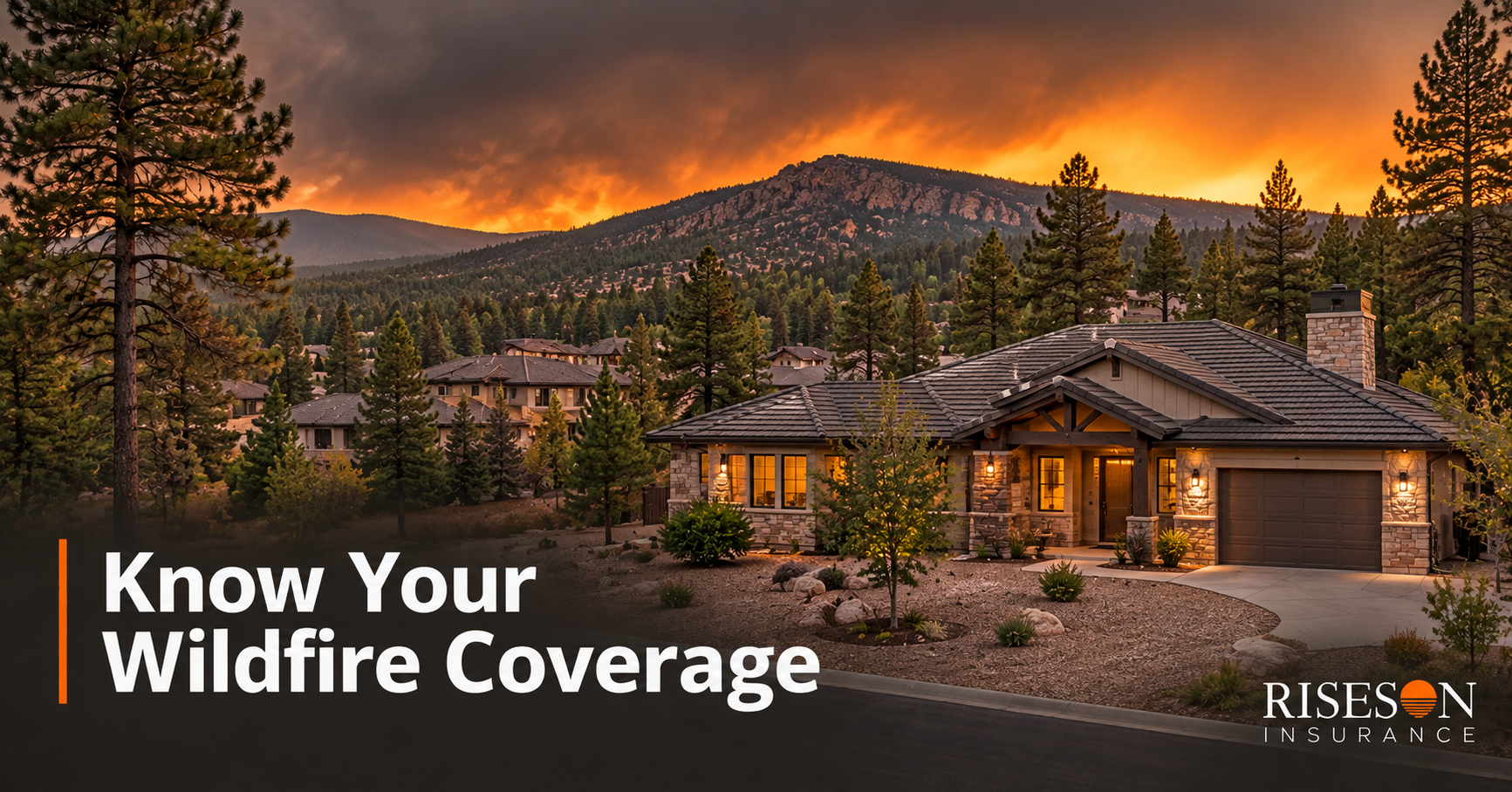
Yes, standard homeowners insurance covers wildfire damage. The fire itself, smoke damage to your home and belongings, and additional living expenses while you're evacuated are all typically included in a standard policy. That part is straightforward.
The harder question is whether you can get or keep that coverage if your home sits in one of Arizona's high-risk zones. That is where the situation has changed significantly.
Arizona's 2025 wildfire season burned an estimated 678,000 acres statewide, roughly 40 percent above the five-year average, according to
Wikipedia's 2025 Arizona wildfires summary. The Dragon Bravo Fire alone consumed 145,504 acres and destroyed 113 structures, including the historic Grand Canyon Lodge. Nationally, 12,773 residential properties were destroyed by wildfire in 2025, per the
National Interagency Fire Center's annual report.
Carriers have noticed. In Prescott, homeowners report premiums doubling overnight. In Flagstaff and Sedona, parts of northern Arizona carry the worst possible ISO fire protection classification, a Class 10, which most standard carriers will not insure at all. The list of willing insurers is shrinking as wildfire scores rise.
The real risk in Arizona's wildfire zones is not just the fire. It is losing your insurance before a fire ever starts.
What Standard Homeowners Insurance Covers in a Wildfire
A standard homeowners insurance policy (HO-3 form) treats wildfire as a covered peril under the dwelling, other structures, and personal property sections. Here is what that coverage typically includes:
- Dwelling coverage (Coverage A): Repairs or rebuilds your home's structure if damaged or destroyed by fire or smoke
- Other structures (Coverage B): Covers detached garages, fences, and outbuildings on your property
- Personal property (Coverage C): Replaces furniture, clothing, electronics, and other belongings damaged by fire or smoke
- Additional living expenses (Coverage D): Pays for hotel stays, meals, and other costs if you are displaced during an evacuation or while your home is being repaired
- Liability (Coverage E): Protects you if fire spreads from your property and damages a neighbor's home
One thing standard policies do not cover: flooding caused by post-fire erosion and debris flows. After a wildfire, burned hillsides become prone to flash flooding and mudslides. That risk requires a separate flood insurance policy.
The coverage itself is not the gap. The gap is the dwelling limit, which we address in the replacement cost section below.
Where Arizona Wildfire Risk Is Concentrated
Not all of Arizona carries the same wildfire exposure. The highest-risk areas sit in the Wildland-Urban Interface (WUI), where residential neighborhoods meet undeveloped, fire-prone land. The
Cotality 2025 Wildfire Risk Report identified Arizona as having 123,906 homes at moderate or greater wildfire risk, with a combined reconstruction cost value of $39.2 billion.
The communities that draw the most carrier scrutiny include:
- Prescott and Prescott Valley: The Flagstaff and Prescott metros rank among the nation's top 15 most at-risk areas by number of homes. Yavapai County's WUI population grew by 126% between 1990 and 2020, and roughly 12% of Prescott-area homeowners now carry no insurance at all.
- Flagstaff: The Flagstaff metro has 33,466 homes at moderate or greater risk, with $10.6 billion in reconstruction value at stake. Parts of northern Arizona near Flagstaff carry an ISO Class 10 fire protection rating, the worst possible score.
- Sedona: Areas near Sedona also rank Class 10 in some zones, according to the
Arizona Department of Insurance and Financial Institutions (DIFI).
- Payson and the Rim Country: Dense ponderosa pine forests and limited road access create high wildfire hazard scores.
- Fountain Hills: Proximity to the McDowell Mountains and Tonto National Forest puts this community in the carrier conversation.
- Catalina Foothills (Tucson area): Foothills terrain and dry brush create elevated interface risk.
38 Arizona communities are currently classified as ISO 8B or worse, meaning fire protection resources are limited and standard carriers are cautious. Communities rated Class 10 are typically declined by admitted carriers altogether.
How Carriers Underwrite Wildfire Risk in Arizona
When a carrier evaluates a home in a WUI area, they are not just looking at your ZIP code. They are running your property through a multi-factor scoring model that weighs several variables simultaneously.
The ISO Public Protection Classification (PPC)
The most common framework is the
ISO Public Protection Classification, a score from 1 (best) to 10 (worst) that measures a community's fire suppression capabilities: fire departments, water supply, emergency communications, and community risk reduction programs. Most standard carriers will not write homes in Class 10 communities. Class 8B and 9 properties face higher premiums and more restrictive underwriting.
Wildfire Scores: Verisk FireLine and CoreLogic
Beyond ISO, many carriers use proprietary wildfire risk scores from vendors like Verisk FireLine or CoreLogic. These models factor in:
- Distance to wildland fuel (grass, brush, timber)
- Slope and terrain (steeper grades accelerate fire spread)
- Historical fire frequency in the area
- Wind patterns
- Ember travel distance from surrounding vegetation
Arizona does not require carriers to disclose your property's wildfire score, but a licensed agent can often access it and tell you where you stand.
Defensible Space and Roof Class
Carriers also look at property-level conditions. Two factors carry the most weight:
- Defensible space: Most carriers require at least 30 feet of vegetation clearance around the structure; some require 100 feet, divided into three zones (0-5 feet ember-resistant, 5-30 feet lean/clean/green, 30-100 feet reduced fuel). If a carrier non-renews your policy for insufficient defensible space, Arizona law requires them to give you notice and an opportunity to correct it within 30 days.
- Roof class: Class A fire-rated roofing (tile, metal, asphalt shingles) dramatically improves eligibility. Wood shake or shingle roofs are frequently declined in WUI zones.
Wildfire risk in Arizona can drive premiums 30 percent or higher compared to a similar home outside the WUI, and some carriers are declining coverage entirely in the highest-risk areas.
Arizona Has No FAIR Plan: What Happens If a Carrier Declines You
This is the part that catches most Arizona homeowners off guard.
In California and Florida, homeowners who cannot find standard coverage have a state-backed insurer of last resort called a FAIR Plan. Arizona has no equivalent. As of 2026,
Arizona does not operate a FAIR Plan or any state-mandated residual market. State officials have discussed creating a wildfire backstop, but nothing has been enacted.
If admitted carriers decline your home, your primary alternative is the surplus lines market.
What Is Surplus Lines Insurance?
Surplus lines carriers (also called excess and surplus, or E&S, carriers) are insurers not licensed through Arizona's standard admitted process. They can write risks that standard carriers won't, including homes in extreme WUI zones. The trade-offs are significant:
- Premiums: Surplus lines policies in wildfire-exposed areas can run two to five times the prior admitted-market rate. E&S policies in high-risk Arizona zones often run $5,000 to $10,000 per year or higher.
- Coverage breadth: Many surplus lines policies are "named perils" only, covering specifically listed causes of loss rather than everything except what is excluded. Personal property and liability coverage may be limited or excluded entirely.
- Consumer protections: Surplus lines carriers are not covered by the Arizona Insurance Guaranty Fund. If the carrier becomes insolvent, your claims may not be paid.
The
Arizona DIFI publishes a list of insurers willing to cover WUI-area homes, updated as of May 2026. That list is a starting point, but availability still depends on your specific location and property conditions.
The bottom line: Arizona's lack of a FAIR Plan means that documented wildfire mitigation and early shopping matter more here than in most states. There is no guaranteed backstop. Once admitted carriers leave your area, your options narrow quickly and get significantly more expensive.
Extended vs. Guaranteed Replacement Cost: Why Your Dwelling Limit Matters More in Wildfire Zones
Even homeowners who keep their standard coverage often discover a second problem at claim time: their dwelling limit is not enough to rebuild.
Wildfire losses are different from most other claims. When a fire destroys a neighborhood, it destroys dozens or hundreds of homes simultaneously. Local contractors and building materials get scarce overnight. Rebuild costs spike. A home insured for $400,000 may cost $550,000 or more to reconstruct after a major wildfire event.
This is where replacement cost coverage options become critical.
Standard Replacement Cost
A standard dwelling limit pays up to the stated policy amount to rebuild. If your limit is $400,000 and the rebuild costs $550,000, you absorb the difference. Many homeowners in wildfire zones discover this gap only after a total loss.
Extended Replacement Cost
Extended replacement cost adds a buffer, typically 25 to 50 percent above your dwelling limit, to account for post-disaster cost spikes. If your limit is $400,000 with 25 percent extended replacement cost, you have up to $500,000 available.
Guaranteed Replacement Cost
Guaranteed replacement cost pays the full cost to rebuild, regardless of the policy limit, as long as your home was accurately insured at policy inception and you kept up with annual reviews. This is the strongest protection available in wildfire zones, though not all carriers offer it and it comes at a higher premium.
The practical takeaway: In Arizona's WUI communities, where rebuild costs have risen sharply and contractor availability tightens after a major fire, extended or guaranteed replacement cost coverage is not a luxury. It is the difference between being made whole and being underinsured when it matters most.
Review your dwelling limit annually. If you have not had a coverage review in the last two years, it is worth having an agent run a current replacement cost estimate on your home.
Defensible Space Steps That Can Improve Your Insurability
Defensible space is the most effective action a WUI homeowner can take to maintain admitted-market eligibility. It also directly reduces your actual risk. Carriers notice both.
The
University of Arizona Cooperative Extension's Wildfire Hazard Severity Rating Checklist uses a point-based scoring system where defensible space is one of the highest-weighted factors. A home with no defensible space treatment scores 10 points in that category alone; a home with 100 feet of treatment scores just 1.
Here is how to structure your defensible space in the three zones most carriers evaluate:
- Zone 1 (0-5 feet from the structure): Create an ember-resistant zone. Use non-combustible mulch like gravel or rock. Remove all dead plants, wood piles, and combustible doormats. Ensure vents are screened with fine metal mesh.
- Zone 2 (5-30 feet): Keep it lean, clean, and green. Remove dead vegetation, fallen leaves, and branches. Space shrubs and trees so fire cannot easily travel between them. Cut grass to a maximum of 4 inches.
- Zone 3 (30-100 feet): Reduce fuel density. Create horizontal and vertical spacing between plants. Remove ladder fuels (low branches that allow ground fire to climb into the tree canopy).
Other Property Improvements That Matter to Carriers
- Install a Class A fire-rated roof (tile, metal, or asphalt shingles). Wood shake roofs are a frequent reason for non-renewal.
- Replace wood decks with composite or non-combustible materials.
- Screen gutters and eave vents to prevent ember intrusion.
- Remove combustible fencing that connects directly to the home.
Defensible space improvements can reduce your premium by 10 to 15 percent while simultaneously improving your home's actual survivability. If a carrier has non-renewed your policy citing a specific curable condition, Arizona law gives you 30 days to correct it and requires the carrier to reinstate coverage if you do.
Frequently Asked Questions
Does homeowners insurance cover wildfire damage in Arizona?
Yes. A standard homeowners insurance policy (HO-3) covers fire as a named peril. That includes direct fire damage, smoke damage, and additional living expenses if you are evacuated or displaced while your home is being repaired. The coverage question most Arizona homeowners actually face is not whether wildfire is covered, but whether they can get or keep a standard policy in a high-risk zone.
Can I get home insurance if I live in a wildfire zone in Arizona?
Yes, but it depends on your property's risk profile. Carriers evaluate your ISO fire protection classification, wildfire score (Verisk FireLine or CoreLogic), defensible space, and roof type. In moderate-risk areas, standard admitted carriers are still writing policies. In extreme-risk zones (Class 10 communities), you may need to work with a surplus lines broker to find coverage. The
Arizona DIFI maintains a list of carriers willing to write WUI-area homes.
Does Arizona have a FAIR Plan for wildfire?
No. Arizona does not have a state-operated FAIR Plan or insurer of last resort. If admitted carriers decline your home, your primary option is the surplus lines (E&S) market. Surplus lines policies can cost significantly more and offer narrower coverage than standard policies, and they are not backed by the Arizona Insurance Guaranty Fund.
What happens if my carrier non-renews my policy because of wildfire risk?
Arizona law requires your carrier to provide advance written notice before non-renewal and to specify any curable conditions (like insufficient defensible space). If you correct the condition within 30 days in a manner acceptable to the insurer, the policy must be renewed. If the non-renewal is based on location rather than a curable condition, you will need to shop for replacement coverage. Start immediately. Do not wait until the policy expires.
What is defensible space and does it affect my premium?
Defensible space is the buffer zone of cleared or reduced vegetation around your home that slows fire spread and reduces ember ignition. Most carriers require a minimum of 30 feet; some require 100 feet for WUI properties. Documented defensible space can reduce your premium by 10 to 15 percent and significantly improves your eligibility for admitted-market coverage.
Talk to a Broker Who Knows Arizona's Wildfire Market
Wildfire insurance in Arizona is not a one-size-fits-all problem. A home in Prescott faces a different carrier landscape than a home in Fountain Hills or the Catalina Foothills. The right policy depends on your property's wildfire score, ISO classification, defensible space condition, roof type, and which carriers are actively writing in your area right now.
At Riseson Insurance, we work with 20+ carriers and can access both the admitted market and surplus lines options. That means we can shop your risk across the full market, not just the carriers one company represents.
Whether you are shopping for a new policy, facing a non-renewal, or just want to know where your current coverage stands, we can help you understand your options before you need to use them.
Contact Riseson Insurance at 602-460-5470 or visit
risesoninsurance.com to talk through your wildfire zone coverage options.