Flood Insurance in Arizona: Why Your Home Insurance Is Not Enough
Standard homeowners insurance does not cover flooding. Not a partial exclusion, not a gray area. Flood damage from rising water is categorically excluded from every standard home policy in Arizona, and most homeowners don't find that out until they're filing a claim.
The problem is compounded by a common assumption: that flooding is a coastal or river-country problem. It isn't. Arizona has some of the highest per-capita flash flood risk in the United States, according to the
National Weather Service Phoenix office, and the reason has everything to do with the ground beneath your feet.
The bottom line: If your home floods and you don't have a separate flood insurance policy, you're paying for every dollar of damage out of pocket.
Why Homeowners Insurance Doesn't Cover Floods
Insurance policies are built around the source of water damage, not the damage itself. That distinction matters more than most people realize.
Rising Water vs. Wind-Driven Rain
A standard homeowners policy covers water damage that originates inside or above the structure: a burst pipe, a roof leak from wind, or rain that enters through a storm-damaged window. What it excludes is water that rises from the ground up. That category, called "flood" in insurance terms, includes:
- Overflow from rivers, washes, and arroyos
- Storm surge and surface water runoff
- Flash flooding from monsoon rainfall
- Water that backs up from overwhelmed storm drains
The distinction sounds technical, but the real-world result is simple: if water enters your home from outside at ground level or below, your homeowners policy won't pay for it.
The Flood Exclusion Is Universal
This isn't a quirk of one carrier or one policy type. The flood exclusion is standard across every homeowners policy in Arizona, whether you're insured through a large national carrier or a regional one. It's also why the federal government created the
National Flood Insurance Program (NFIP): to fill a gap the private market largely wouldn't cover.
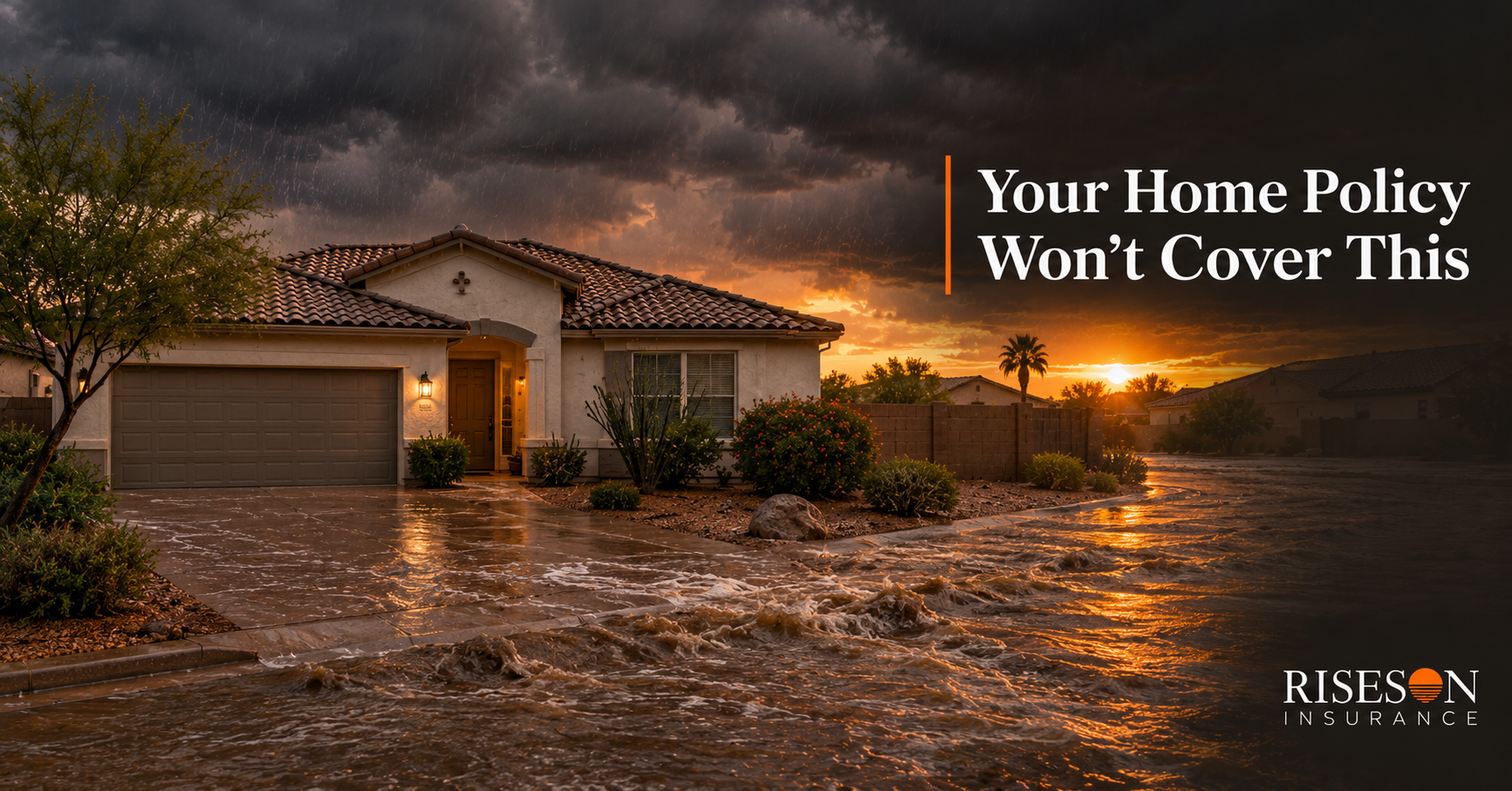
What this means for Phoenix-area homeowners: A monsoon storm that pushes water through your garage door, across your patio, and into your living room is a flood event. Your home policy will deny that claim. The only coverage that responds is a separate flood insurance policy.
Arizona's Flash Flood Risk Is Not What You'd Expect
Most people picture flood risk as proximity to a river or coastline. In Arizona, that mental model is wrong, and it's the reason so many homeowners are underinsured.
The Caliche Problem
Much of the Phoenix Valley sits on caliche, a calcium carbonate hardpan layer that can run from a few inches to several feet thick. Caliche is virtually impervious to water. When rain hits it, the water doesn't soak in. It runs off almost immediately, the same way it would off a concrete parking lot.
That means even a modest monsoon storm generates dramatic runoff volumes. A storm that drops one to two inches of rain over the White Tank Mountains can send a flash flood surge into Buckeye, Goodyear, or Avondale 45 minutes later, even if those communities received little or no rainfall themselves.
What Makes Arizona Flood Risk Unique
- Hardpan soil: Caliche and compacted desert soil shed water rather than absorbing it, multiplying runoff from any rainfall event
- Dry washes and arroyos: These drainage corridors can be completely dry for 11 months and then carry tens of thousands of cubic feet per second within 20 minutes of an upstream storm
- Burn scars: Wildfire strips vegetation and destroys soil structure, leaving hillsides unable to absorb any rainfall for up to five years after a fire, according to
FEMA's FloodSmart program
- Monsoon intensity: Rainfall in Maricopa County can exceed 3 inches per hour during peak monsoon events, overwhelming detention basins and drainage systems designed for lesser flows
- Urban hardscape: Roads, parking lots, and rooftops in the Phoenix metro act like caliche, redirecting rainfall into streets and low-lying properties
The result: Flash flood risk in Arizona is ranked among the highest per capita in the nation, and it's not confined to the areas FEMA has mapped as high-risk.
FEMA Flood Maps: Why Being in Zone X Doesn't Mean You're Safe
FEMA's Flood Map Service Center assigns every property in the country a flood zone designation. Understanding what those zones mean, and what they don't, is essential for any Arizona homeowner.
The Key Flood Zone Designations in Arizona
- Zone AE: High-risk. FEMA has completed detailed engineering analysis and established a specific Base Flood Elevation. Common near major Maricopa County waterways including Indian Bend Wash in Scottsdale, the Salt River corridor, the Agua Fria River, and the Gila River. Flood insurance is mandatory for federally backed mortgages in this zone.
- Zone A: High-risk. Carries the same 1% annual flood probability as Zone AE (the so-called "100-year flood"), but FEMA has not completed detailed study to establish an exact Base Flood Elevation. Most common near smaller, unstudied washes and drainage corridors. Flood insurance is mandatory for federally backed mortgages.
- Zone AH: Shallow flooding areas where water typically ponds rather than flows. Depths of one to three feet. Still requires flood insurance on federally backed loans.
- Zone X (unshaded): Moderate to minimal risk. No mandatory flood insurance requirement. This is where most Greater Phoenix homeowners believe they have nothing to worry about.
The Problem With Zone X
Being in Zone X does not mean your property can't flood. It means FEMA's engineering models didn't classify it as a high-risk zone at the time the maps were drawn. Those maps have limitations:
- They are updated infrequently and may not reflect recent development, new drainage infrastructure, or post-wildfire soil changes
- They don't account for the hyperlocal runoff patterns created by Arizona's caliche soil
- They can't predict where a monsoon storm cell will drop its heaviest rain
The data is stark:
FEMA reports that nearly one in three flood insurance claims nationwide comes from outside designated high-risk flood zones. In Arizona, with its caliche soil and unpredictable monsoon geography, that ratio may be higher.
Fewer than 1 in 100 Arizona homes currently carry an NFIP policy, even though flash flooding is one of the state's most frequent and costly hazards.
NFIP vs. Private Flood Insurance: Which Is Right for You?
Arizona homeowners have two options for flood coverage: the federal NFIP program and private flood insurance carriers. Neither is automatically better. The right choice depends on your property's risk profile, your coverage needs, and your budget.
NFIP (National Flood Insurance Program)
The NFIP is administered by FEMA and sold through licensed insurance agents. It's the most widely available option and the one required by lenders for properties in high-risk flood zones.
- Who offers it: Available through independent agents like Riseson Insurance and many other licensed producers
- Building coverage: Up to $250,000 for the structure
- Contents coverage: Up to $100,000 for personal property (purchased separately)
- Average Arizona premium: Approximately $839 per year, based on NFIP data for the trailing 12 months
- Waiting period: 30 days before coverage takes effect (with limited exceptions for loan closings)
- Pricing model: Under FEMA's Risk Rating 2.0, premiums are property-specific based on flood frequency, distance to water, elevation, and rebuild cost
- Basement coverage: Limited. Personal property in basements and below-grade spaces has restricted coverage under NFIP
- Best for: Properties in mandatory flood zones, homeowners who want federally backed coverage, buyers with federally backed mortgages requiring NFIP
Private Flood Insurance
Private flood insurance is offered by a growing number of carriers and can often be purchased through the same independent agent who handles your home policy.
- Building coverage: Often higher limits than NFIP's $250,000 cap, which matters in higher-value Phoenix-area homes
- Contents coverage: Typically higher limits and broader coverage than NFIP
- Waiting period: Often shorter than NFIP's 30 days; some carriers offer 10-14 day waiting periods
- Pricing: Can be lower than NFIP for lower-risk Zone X properties; can be higher for high-risk zones
- Additional living expenses: Some private policies cover temporary housing if your home is uninhabitable after a flood; NFIP does not
- Basement coverage: Generally broader than NFIP
- Best for: Higher-value homes that exceed NFIP limits, Zone X homeowners seeking optional coverage, homeowners who want broader coverage terms
The One Rule That Applies to Both
Neither NFIP nor private flood insurance is a same-day purchase. The standard NFIP waiting period is 30 days. Most private carriers have waiting periods of 10 to 30 days. If a storm is already in the forecast, it's too late to buy coverage that will respond to it.
That 30-day window is the single most important reason flood insurance is a year-round conversation, not a monsoon-season scramble.
Frequently Asked Questions
Does homeowners insurance cover flooding in Arizona?
No. Standard homeowners insurance excludes flood damage, defined as water that rises from the ground or flows in from outside the structure. This exclusion applies to every standard home policy in Arizona, regardless of carrier. A separate flood insurance policy, either through the NFIP or a private carrier, is required for flood coverage.
Do I need flood insurance if I'm not in a FEMA flood zone?
Not legally, unless your lender requires it. But "not required" is different from "not at risk." FEMA data shows nearly one in three flood insurance claims nationally come from outside designated high-risk zones. In Arizona, caliche soil, dry washes, burn scars, and monsoon storm patterns create significant flood exposure for properties in Zone X. Flood insurance is available to any homeowner, regardless of zone designation.
How much does flood insurance cost in Arizona?
The average NFIP flood insurance premium in Arizona is approximately $839 per year, based on trailing 12-month NFIP data. Premiums vary significantly by property. Zone AE properties, which carry the highest risk, average closer to $1,103 per year. Properties in lower-risk zones typically pay less. Private flood insurance may be priced differently, sometimes lower for Zone X properties.
How long does it take for flood insurance to go into effect?
The NFIP has a standard 30-day waiting period from the date of purchase before coverage takes effect. There are limited exceptions, primarily for flood insurance purchased at the time of a loan closing. Many private flood carriers have shorter waiting periods of 10 to 14 days. Either way, flood insurance cannot be purchased when a storm is already threatening.
Can renters or condo owners get flood insurance?
Yes. NFIP contents coverage is available to renters and covers personal property up to $100,000. Condo owners can purchase NFIP building coverage for their individual unit, and their condo association may carry a separate master flood policy for the building structure. Private flood options for renters and condo owners also exist. If you rent or own a condo in a flood-prone area of Greater Phoenix, coverage is worth exploring.
Get Flood Coverage Before the Next Storm
The 30-day waiting period is the only hard deadline in flood insurance. Everything else, choosing between NFIP and private coverage, understanding your flood zone, deciding how much building and contents coverage you need, can be worked through with time and the right guidance. But that conversation has to happen before a storm is in the forecast.
At Riseson Insurance, we work with homeowners across Scottsdale, Tempe, Chandler, and the broader Phoenix metro to find flood coverage that fits their property and their budget. As an independent agency, we can shop both NFIP and private flood options and help you understand what each policy actually covers before you need to use it.
Ready to get a flood insurance quote? Call us at 602-460-5470 or reach out through
risesoninsurance.com to start the conversation. Don't wait for monsoon season to remind you.