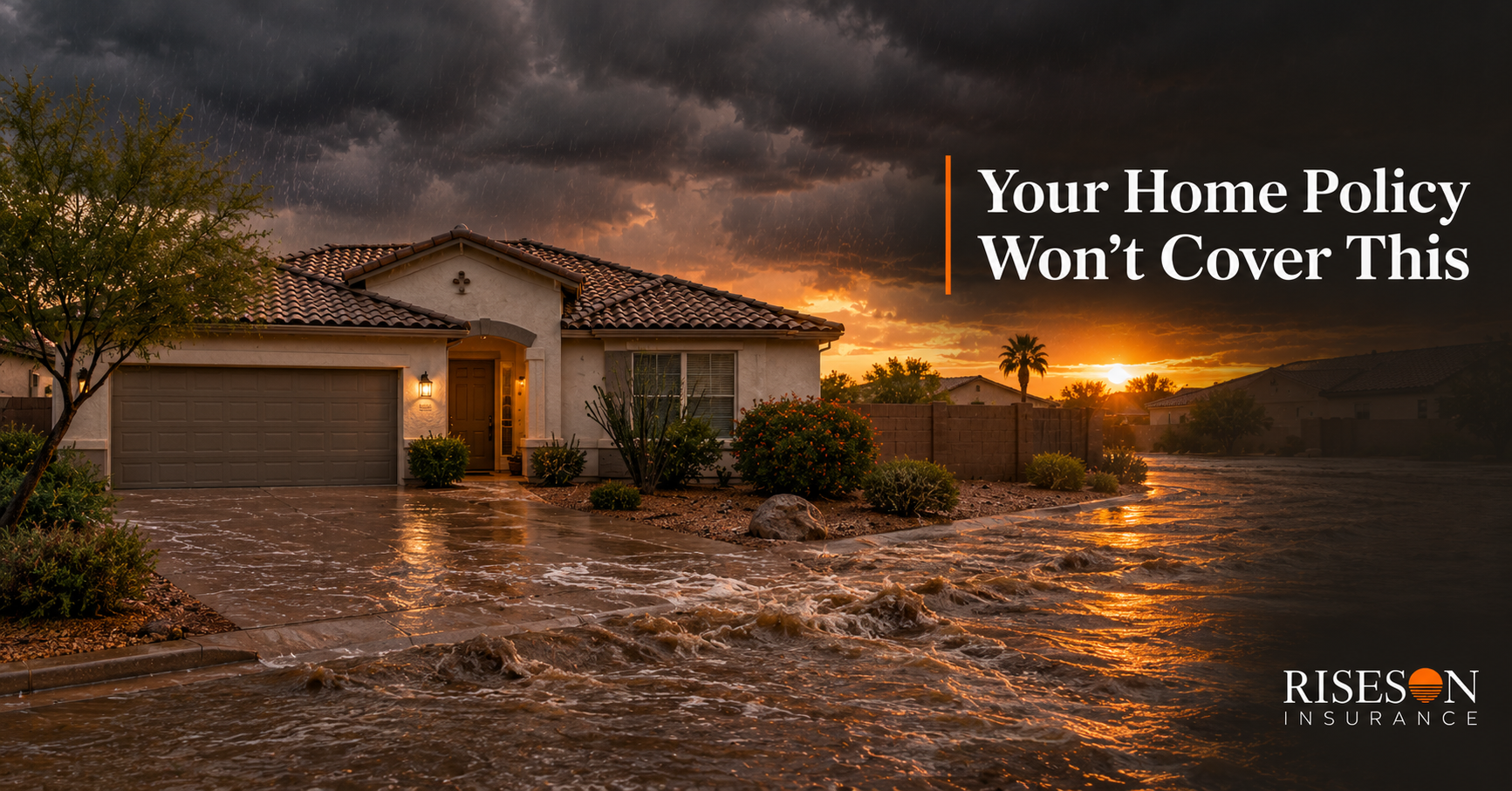
How Much Does Homeowners Insurance Cost in Arizona in 2026?
The short answer: Arizona homeowners pay an average of
$2,172 per year for home insurance with $300,000 in dwelling coverage, according to
Insurify's November 2026 data. That works out to roughly
$181 per month, and it sits well below the national average of $2,772 per year.
That headline number is a useful starting point. But it is not your number.
Two homes on the same Scottsdale street, with the same square footage and the same purchase price, can carry premiums that differ by more than $2,000 a year. The statewide average tells you nothing about a 22-year-old tile roof, a wildland-urban interface ZIP code, or a credit score that needs work. Those variables are what actually set your rate.
What this guide covers:
- Arizona's average home insurance cost by coverage level
- The six factors that move your specific premium
- How Arizona compares to neighboring states
- The biggest levers for lowering your bill
- Why shopping multiple carriers is the single most effective strategy
Arizona Home Insurance Cost by Coverage Level
Dwelling coverage is the core of your homeowners policy. It pays to rebuild your home from the ground up after a covered loss. The amount you choose directly drives your premium, and the right amount is your home's
rebuild cost, not its market value or purchase price.
Here are Arizona's average annual premiums by dwelling coverage level, based on
insure.com's 2026 analysis using Quadrant Data Services rates with a $1,000 deductible:
- $200,000 in dwelling coverage: ~$1,821/year ($152/month)
- $300,000 in dwelling coverage: ~$2,344/year ($195/month)
- $400,000 in dwelling coverage: ~$2,875/year ($240/month)
- $500,000 in dwelling coverage: ~$3,336/year ($278/month)
Important context: These are averages across all Arizona homes and carriers. Your actual quote may land significantly higher or lower depending on your specific property and insurer. In a
MoneyGeek analysis of 4.2 million Arizona quotes, the spread between the cheapest and most expensive carrier for the same home exceeded $5,376 per year.
How to determine your dwelling coverage amount
The most common mistake Arizona homeowners make is setting their dwelling coverage equal to their home's market value or what they paid for it. Those numbers are irrelevant to an insurer. What matters is the cost to rebuild, which in Greater Phoenix means accounting for current labor rates, materials, and the square footage of your specific home.
A licensed agent can run a replacement cost estimate for you before binding a policy. Underinsuring your dwelling to save on premium can leave you with a serious gap at claim time.
What Actually Drives Your Rate in Arizona
Arizona's pricing environment has some quirks that don't apply in other states. Understanding them helps you know where you have leverage and where you don't.
Roof age and type
This is the single biggest property-level variable in Arizona. Most carriers charge meaningfully higher rates for roofs over 15 years old, and some will not offer replacement cost coverage at all for roofs older than 20 years without a current inspection. Arizona's intense UV exposure and monsoon hail accelerate roof wear faster than in cooler climates, so insurers treat roof age as a reliable claims predictor.
A new roof is one of the few property improvements that produces a measurable, immediate reduction in your premium.
Wildfire exposure
Homes in or near Arizona's wildland-urban interface, particularly in the Flagstaff, Prescott, Sedona, and Rim Country areas, face a different underwriting environment than Phoenix Metro properties. Carriers may charge higher premiums, apply stricter underwriting criteria, or decline to renew policies in high-risk zones. The
Arizona Department of Insurance and Financial Institutions (DIFI) maintains a list of carriers willing to write policies in wildfire-prone areas.
Phoenix Metro homeowners are largely insulated from wildfire surcharges, but the risk is not zero in outlying communities.
Rebuild cost and home characteristics
- Home age: Newer homes average $137/month; older homes average $231/month in Arizona, a $1,128 annual difference, per MoneyGeek data.
- Construction type: Adobe and historic stucco exteriors carry higher rebuild costs and specialized repair needs.
- Pool and outdoor amenities: Arizona has one of the highest backyard pool rates in the country. Pools add to both your rebuild cost and your liability exposure.
- Square footage and finishes: Custom tile work, high-end cabinetry, and larger homes push rebuild costs up.
Credit-based insurance score
Arizona allows insurers to use credit-based insurance scores when setting premiums. The gap is substantial. MoneyGeek's analysis of Arizona quotes found homeowners with excellent credit paid an average of $85/month, while those with poor credit paid $364/month, a
$3,348 annual difference for identical coverage. That is one of the largest credit-pricing gaps in the country.
Claims history
A clean five-year record saves money. Arizona homeowners with two claims in the past five years pay roughly $1,008 more per year than those with no claims, according to MoneyGeek data. Before filing a claim for a smaller loss, weigh the repair cost against three to five years of potential surcharges.
Location within Arizona
Even within the Phoenix Metro, ZIP code matters. Monsoon exposure, hail frequency, proximity to fire stations, and local construction costs all vary. Insurify data shows Phoenix averaging $2,136/year for $300K coverage versus $1,932/year in Tucson for the same policy.
How Arizona Compares to Neighboring States
Arizona's average sits comfortably below the national figure, and it compares favorably to most of its neighbors. Here's how the region stacks up for $300K in dwelling coverage, based on
Insurify's November 2026 state-by-state data:
- Arizona: ~$2,172/year ($181/month)
- California: ~$2,040/year ($170/month)
- Nevada: ~$1,524/year ($127/month)
- Utah: ~$1,344/year ($112/month)
- New Mexico: ~$2,400/year ($200/month)
- National average: ~$2,772/year ($231/month)
The takeaway: Arizona is not the cheapest state in the region, but it is well below the national average. The favorable position reflects Arizona's relatively low catastrophic storm exposure compared to Gulf Coast and Midwest states, where hurricane, tornado, and severe hail risk push premiums significantly higher.
That said, Arizona's rates have been climbing. Insurify's mid-2026 report found Arizona premiums rose 1.8% in the first half of 2026, with some counties seeing spikes of up to 33%. Wildfire expansion into the wildland-urban interface and rising construction costs are the primary drivers.
The Biggest Levers for Lowering Your Premium
Not every factor on your policy is fixed. Several of the most impactful ones are within your control.
Raise your deductible strategically
Your deductible is the amount you pay out of pocket before your policy responds to a claim. Moving from a $1,000 deductible to a $2,500 deductible typically produces a meaningful premium reduction. The trade-off is real: you need to be able to cover that deductible in a claim scenario. For homeowners who rarely file claims and have emergency savings, a higher deductible often makes financial sense.
Document your roof
If your roof is newer, carriers want to know. Providing documentation of a recent replacement, including the permit, contractor invoice, and material specs, can move your rate in the right direction. Tile and metal roofs also tend to outperform asphalt shingles in Arizona's underwriting environment because of their durability against UV and monsoon hail.
Bundle your home and auto policies
Most carriers offer a multi-policy discount when you insure both your home and vehicle through the same company. The discount typically ranges from 5% to 20%, and it is one of the easiest savings to capture without changing your coverage at all.
Work on your credit score
Arizona's credit-pricing gap is among the largest in the country. Even moving from "fair" to "good" credit can produce a noticeable reduction at your next renewal. Paying bills on time and reducing credit card balances are the most direct paths.
Take wildfire mitigation steps
For homes in or near wildfire-risk areas, creating defensible space, using fire-resistant materials, and participating in programs like
Firewise USA can help with both access to coverage and premium levels. Some Arizona carriers explicitly recognize these efforts in their underwriting.
Why Shopping Multiple Carriers Matters More Than Any Single Factor
Here is the part most homeowners skip: the insurer you choose affects your rate more than your location, credit score, or claims history, according to MoneyGeek's Arizona analysis. Two carriers looking at the identical home profile can produce quotes that differ by thousands of dollars per year because each company uses its own proprietary formula to weight rating factors.
That is the core argument for working with an independent insurance agent rather than going directly to a single carrier. A captive agent represents one company and can only show you that company's rates. An independent agent has access to multiple carriers and can compare them side by side for your specific home, ZIP code, and profile.
At Riseson Insurance, we work with 20+ carrier partners across Arizona. When we quote a home, we are not steering you toward one company's product. We are finding which carrier's underwriting model treats your specific home most favorably, and that difference is often substantial.
The right question isn't "what does Arizona average?" It's "what should I be paying for my home, with my roof, in my ZIP code, at my coverage level?"
Get a free home insurance quote from Riseson Insurance and see what multiple carriers would actually charge for your property. The comparison takes minutes and the savings can be significant.
Frequently Asked Questions
What is the average homeowners insurance cost in Arizona per month?
Arizona homeowners pay an average of $181 per month for a policy with $300,000 in dwelling coverage and a $1,000 deductible, according to Insurify's November 2026 data. The national average for the same coverage is $231 per month. Your actual rate will vary based on your home's rebuild cost, roof age, location, credit score, and claims history.
Is homeowners insurance required in Arizona?
Arizona does not legally require homeowners insurance. However, if you have a mortgage, your lender will require it as a condition of the loan. Even without a mortgage, carrying coverage is strongly advisable: the average cost to rebuild a home after a total loss far exceeds what most homeowners could absorb out of pocket.
Does homeowners insurance in Arizona cover flood damage?
Standard homeowners policies in Arizona do not cover flood damage from rising water. Wind and hail damage from monsoon storms are typically covered, but if water enters your home from the ground up (flash flooding), you need a separate flood policy through the
National Flood Insurance Program (NFIP) or a private flood carrier.
How does roof age affect my Arizona home insurance rate?
Roof age is one of the most significant rating factors in Arizona. Most carriers charge higher rates for roofs over 15 years old. Some will not offer replacement cost coverage for roofs older than 20 years without a current inspection, and a few may decline to renew coverage entirely. A documented roof replacement can lower your premium and restore full replacement cost coverage.
How can I lower my homeowners insurance premium in Arizona?
The most impactful steps are: shop multiple carriers (the spread between the cheapest and most expensive can exceed $5,000/year for the same home), raise your deductible if you have adequate savings, bundle home and auto with the same carrier, document any recent roof replacement, and work on improving your credit score. An independent agent can run these comparisons for you across multiple carriers at once.